


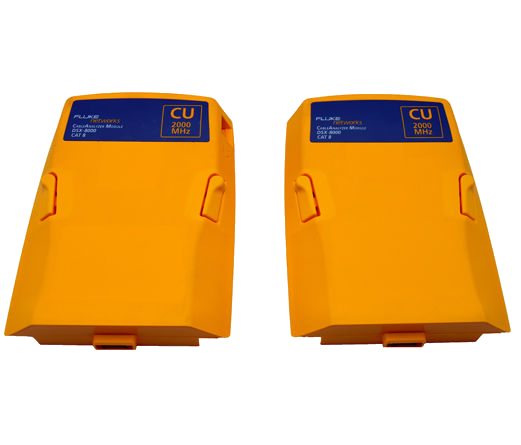
Fluke Networks DSX-8000-ADD
Cat 5e/6/6A/8 or Class FA and I/II Copper modules for Versiv
Rent or Lease
Fluke Networks - DSX-8000-ADD
The Fluke Networks DSX-8000-ADD belongs to the Versiv cabling certification product family and can certify Cat 5e, Cat 6, Cat 6A, Cat 8, and Class I/II cabling up to 2,000MHz. The highly durable CableAnalyzer can withstand harsh conditions without compromising on performance.
The Fluke Networks DSX-8000-ADD complies with the Level VI/2G accuracy standards for accelerated system processes and reliable results. The CableAnalyzer features the ProjX management system that helps remove unnecessary, repetitive steps and the Taptive user interface gives you quick and efficient results with advanced data analysis and easy setup options.
DSX-8000-ADD Product Highlights
- Test time:
- Cat 6A/Class EA: 8 seconds
- Cat 8/Class I/II: 16 seconds
- HDTDX/HDTDR diagnostic test times: approximately 3 seconds
- Internal memory: approximately 5,000 Cat 8 with plots; approximately 12,000 Cat 6A with plots
- Channel adapter range: 2GHz
- Permanent link adapter range: 2GHz
- Display: 5.7-inch LCD display with a projected capacitance touch screen
- Support test parameters: Wire map, length, propagation delay, delay skew, DC loop resistance, pair-to-pair
- Resistance unbalance, pair resistance unbalance, Insertion loss (attenuation), RL, CMRL, near end crosstalk, far end crosstalk, attenuation-to-crosstalk ratio (ACR-N), ACR-F (ELFEXT), power sum ACR-F (ELFEXT), power sum NEXT, power sum ACR-N, power sum alien NEXT, power sum alien attenuation NEXT ratio far end, CDNEXT, TCL, ELTCTL
Fluke Networks & TRS-RenTelco
TRS-RenTelco is a proud partner of Fluke Networks and offers a wide range of rental, purchase and leasing solutions designed specifically to meet the evolving needs of the electronic testing industry. Our close relationship with Fluke Networks allows us to ensure we have the right Datacom Cable Test solution for your job.
Renting a Datacom Cable Test
With TRS-RenTelco renting Datacom Cable Test equipment has never been easier. Enjoy same-day shipping, lease, and finance options on our inventory of over 5000 electronic testing equipment rentals. As one of North America’s largest test equipment rental providers, it is our mission to support the endeavors of our clients no matter how big or small with reliable expertise, excellent customer service, accuracy, and speed.
Additional Information
Manufacturer Home Page | Fluke Networks.
- Configurations
- Resources
- Comparisons
- FAQsAI
Base Model
Standard Rental Accessories*
* Leased or Buy Used product accessories will be confirmed with quote.
-
Copper Module
Qty: 2 -
Adapter Channel DSX-CHA804
Qty: 2 -
Adapter Permanent Link 50 cm Ohm
Qty: 2
*This item has already been added to your cart. Check your cart for quantity and availability.

Datasheet - Fluke Networks DSX-8000-ADD
User Manual - Fluke Networks VERSIV2
Video - Setting Up the Fluke Networks DSX-5000 CableAnalyzer

Video - Introduction to Fluke DSX 8000
Video - FLUKE DSX-5000 CableAnalyzer Copper Cable Certifiers Unboxing (Part 1)
Video - FLUKE DSX-5000 CableAnalyzer Setup (Part 2)
Video - FLUKE DSX-5000 CableAnalyzer Copper Cable Certifiers Creating a Report (Part 4)
Video - FLUKE DSX-5000 CableAnalyzer Copper Cable Certifier Running a Test (Part 3)
Video - Testing Live Network Drops with the Fluke DSX CableAnalyzer

Content is AI-generated. Verify critical details with manufacturer-provided resources.
What is the Fluke Networks DSX-8000-ADD and what problems does it solve?
The Fluke Networks DSX-8000-ADD is the DSX-8000 CableAnalyzer add-on kit for the Versiv cabling certification platform. It is built for contractors and in-house teams who need to certify twisted pair copper cabling to standards, deliver customer acceptance reports, and minimize retesting. With DSX-8000 capability, you can certify high performance links up to Category 8 (Class I and Class II) and support modern 25G and 40G copper deployments. The workflow is designed to reduce errors in the field with guided setup, clear pass or fail results, and automated project management.
What copper cabling categories and accuracy levels can the DSX-8000 certify?
DSX-8000 supports copper certification up to Category 8 and Class I or Class II through 2000 MHz (2 GHz). It is designed for high accuracy field testing at these frequencies and is also suited for certification of Category 6A and below. Beyond traditional parameters, DSX-8000 supports balance measurements such as Transverse Conversion Loss (TCL) and Equal Level Transverse Conversion Transfer Loss (ELTCTL), which help evaluate noise immunity, especially in electrically noisy environments.
Can the DSX-8000 test for Alien Crosstalk, and what standards does it support for high-speed Ethernet certification?
Yes, the DSX-8000 has built-in Alien Crosstalk (ANEXT) measurement capability, enabling Power Sum Alien Near End Crosstalk (PS ANEXT) and Power Sum Alien Attenuation Crosstalk Ratio Far End (PS AACR-F) testing required for 25GBASE-T and 40GBASE-T deployments. It supports all TIA-568 series and ISO/IEC 11801 series standards, including Cat 5e, 6, 6A, Cat 8, and Class I/II certification up to 2000 MHz with Level 2G/VI accuracy. The DSX-8000 also measures Transverse Conversion Loss (TCL) and Equal Level Transverse Conversion Transfer Loss (ELTCTL) for balance verification, which is critical in industrial environments with high electromagnetic interference.
How fast is DSX-8000 testing, and how does it help reduce rework on big jobs?
DSX-8000 is designed for high throughput certification. For example, Cat 6A certification can be completed in about 8 seconds per test, which reduces total testing time on large bundles. Beyond speed, the bigger time saver is error prevention. The Versiv platform uses ProjX project management to keep naming, limits, and job progress organized, while the Taptive touchscreen interface guides technicians through setup so results stay consistent across crews and shifts.
Can DSX-8000 simplify advanced testing like Alien Crosstalk and balance verification?
Yes. Higher frequency cabling such as Category 8 requires tighter control of noise and coupling. DSX-8000 simplifies complex requirements by integrating support for Alien Crosstalk link-to-link certification up to 40GBASE-T testing. Balance metrics like TCL and ELTCTL help confirm cabling noise immunity expected by the standard, which can be especially relevant in industrial sites with higher electromagnetic interference.
How do I create customer-ready certification reports and share results with stakeholders?
Results can be managed and reported with LinkWare PC software, which consolidates test data and produces professional reports for closeout packages. If you use LinkWare Live, project managers can set up testers, monitor progress, and centralize results across multiple job sites. This helps standardize deliverables, speeds up review, and reduces the risk of missed tests when multiple technicians are involved.
Do I need to calibrate the DSX-8000, and how do I keep measurements reliable during a rental?
For standards-based certification work, keep the tester within the manufacturer recommended service and accuracy verification cycle. In day-to-day use, reliability depends on good practices: set the correct test limit for the cabling class, confirm the adapter type matches the link, keep contacts clean, and avoid stressing the test cords. Use quality patch cords during testing and replace any cord that shows intermittent results when moved. TRS rental units are maintained for field use, and documentation can be provided when required for QA records.
What are best practices for passing Cat 6A or Cat 8 certification on the first attempt?
Start every job by loading the correct limits and cable IDs, then verify you are using the right adapter type for the link (permanent link versus channel, and Cat 8 adapters when needed). Inspect and clean plug and jack contacts, especially after working in dusty ceilings or industrial spaces. Keep patch cords short, avoid sharp bends and kinks, and do not twist the tester cords under tension. If a link fails, review the detailed margins to identify the dominant failure mechanism (NEXT, return loss, insertion loss, alien crosstalk, or balance), then correct that physical issue before retesting.


