


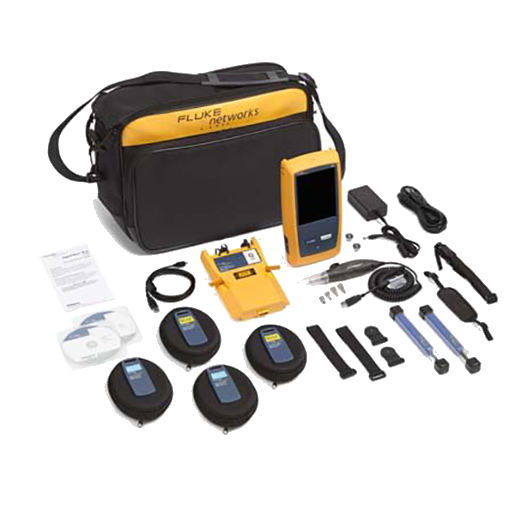
Fluke Networks OFP2-100-QI
OptiFiber Pro Quad OTDR with Inspection Kit
Rent or Lease
Fluke Networks - OFP2-100-QI
The Fluke Networks OFP2-100-QI is the first OTDR built from the ground up for enterprise fiber optic cabling testing. OptiFiber Pro is focused on reducing costs while enhancing productivity and improving network reliability.
OFP2-100-QI Product Highlights
- First OTDR with a smartphone user-interface
- Industry's shortest event and attenuation dead zones
- Accelerate fiber certification with the fastest set-up and trace times
- SmartLoop technology enables the testing of two fibers in a single test eliminating the need to travel to the far end of the connection to perform tests.
- Versiv modular design supports copper certification, fiber optic loss, OTDR testing and fiber end-face inspection
- Instantaneous bi-directional averaging results included at no charge
- Improve resource utilization with custom configurations for projects and users
- Simplify use with %22DataCenter OTDR%22 mode and EventMap view
- Compatible with Linkware Live. Linkware Live enables to easily track job progress, get real-time access to test results to quickly fix problems in the field, and easily transfer and consolidate test results from the tester to LinkWare PC Cable Test Management Software
Fluke Networks & TRS-RenTelco
TRS-RenTelco is a proud partner of Fluke Networks and offers a wide range of rental, purchase and leasing solutions designed specifically to meet the evolving needs of the electronic testing industry. Our close relationship with Fluke Networks allows us to ensure we have the right Optical Test solution for your job.
Renting Optical Test
With TRS-RenTelco renting Optical Test equipment has never been easier. Enjoy same-day shipping, lease, and finance options on our inventory of over 5000 electronic testing equipment rentals. As one of North America’s largest test equipment rental providers, it is our mission to support the endeavors of our clients no matter how big or small with reliable expertise, excellent customer service, accuracy, and speed.
Additional Information
Manufacturer Home Page | Fluke Networks.
- Configurations
- Resources
- FAQsAI
Base Model
Standard Rental Accessories*
* Leased or Buy Used product accessories will be confirmed with quote.
-
Strap
Qty: 1 -
Barrel SC (Simplex)
Qty: 1 -
Barrel Simplex LC
Qty: 1 -
Cable USB-A - USB-MicroB
Qty: 1 -
Battery Pack 39Wh
Qty: 1 -
Launch Cable, Multimode, SC - LC, 50 micron, 100 Meters
Qty: 2 -
Launch Cable SC/UPC- LC/UPC Singlemode
Qty: 2 -
Hand Strap
Qty: 1 -
Adapter SC Interchangeable
Qty: 2 -
Tip Universal Video 2.5 mm (U25)
Qty: 1 -
Tip for Patch Cords Universal 1.25 mm (U125)
Qty: 1 -
Tip Bulkhead LC (LC)
Qty: 1 -
Tip Bulkhead SC and FC (FS)
Qty: 1 -
Adapter Interchangeable for Source Port
Qty: 2 -
Video Probe USB FiberInspector
Qty: 1 -
Case Soft
Qty: 1 -
Case Soft
Qty: 1 -
Mainframe (No Remote) Versiv2
Qty: 1 -
Quad Module OTDR
Qty: 1 -
Software and Manuals on USB
Qty: 1 -
AC Adapter
Qty: 0 -
Box Plastic Compartmented
Qty: 1
*This item has already been added to your cart. Check your cart for quantity and availability.
--, FI-3000, FI1000-1.25-UTIP, FI1000-1.25APC-TIP, FI1000-2.5-UTIP, FI1000-2.5APC-UTIP, FI1000-LC-SQ-TIP, FI1000-LCAPC-TIP, FI1000-SCAPC-TIP, FI1000-SCFC-TIP, MPO-12-24-APC, MPO-12-24-UPC
See Configuration Details
-
FI-3000
Fiber Inspection Probe
-
FI1000-1.25-UTIP
1.25MM UNIVERSAL VIDEO PROBE TIP FOR PATCH CORDS
-
FI1000-1.25APC-TIP
1.25MM APC UNIVERSAL VIDEO PROBE TIP
-
FI1000-2.5-UTIP
2.5MM UNIVERSAL VIDEO PROBE TIP FOR PATCH CORDS
-
FI1000-2.5APC-UTIP
2.5MM APC UNIVERSAL VIDEO PROBE TIP FOR PATCH CORDS
-
FI1000-LC-SQ-TIP
LC SQUARE BULKHEAD VIDEO PROBE TIP
-
FI1000-LCAPC-TIP
LC APC BULKHEAD VIDEO PROBE TIP
-
FI1000-SCAPC-TIP
SC APC BULKHEAD VIDEO PROBE TIP
-
FI1000-SCFC-TIP
SC AND FC BULKHEAD VIDEO PROBE TIP
-
MPO-12-24-APC
MPO 12 and 24 APC (included in base model)
-
MPO-12-24-UPC
MPO 12 and 24 UPC (included in base model)
Standard Rental Accessories*
* Leased or Buy Used product accessories will be confirmed with quote.
-
Case Soft
Qty: 1 -
Case Soft
Qty: 1 -
Hand Strap
Qty: 1 -
Battery Pack 39Wh
Qty: 1 -
Launch Cable, Multimode, SC - LC, 50 micron, 100 Meters
Qty: 2 -
Launch Cable SC/UPC- LC/UPC Singlemode
Qty: 2 -
Mainframe (No Remote) Versiv2
Qty: 1 -
Quad Module OTDR
Qty: 1 -
Strap
Qty: 1 -
FI-3000 FiberInspector Pro.
Qty: 1 -
Barrel Simplex LC
Qty: 1 -
Barrel SC (Simplex)
Qty: 1 -
Tip for Patch Cords Universal 1.25 mm (U125)
Qty: 1 -
Tip Universal Video 2.5 mm (U25)
Qty: 1 -
Tip Bulkhead LC (LC)
Qty: 1 -
Tip Bulkhead SC and FC (FS)
Qty: 1 -
AC Adapter
Qty: 1 -
Adapter Interchangeable for Source Port
Qty: 2 -
Adapter SC Interchangeable
Qty: 2 -
Cable USB-A - USB-MicroB
Qty: 1 -
Software and Manuals on USB
Qty: 1 -
1.25APC Bulkhead probe tip
Qty: 1 -
FI1000-2.5APC-UTIP 2.5MM APC UNIVERSAL V
Qty: 1 -
SC APC bulkhead video probe tip
Qty: 1 -
Carry Holster
Qty: 1 -
Power Supply 5 V 2 A 3 kVAC ISO VI USB Type-C Universal Wall Mount
Qty: 1 -
Box Plastic Compartmented
Qty: 1
*This item has already been added to your cart. Check your cart for quantity and availability.

User Manual - Fluke Networks VERSIV2
Datasheet - Fluke Networks OptiFiber Pro

Video - FLUKE OptiFiber Pro OTDR Fiber Optic Tester with SmartLoop Bi-Directional Averaging
Video - Detecting Splitters on Passive Optical Networks with the Fluke OptiFiber Pro HDR OTDR
Video - Troubleshooting a Live Passive Optical Network with Fluke OptiFiber Pro HDR OTDR
Video - Clearing the memory and all settings in your Fluke OptiFiber Pro OFP 102
Video - Fluke OptiFiber Pro Project Management OFP 108
Content is AI-generated. Verify critical details with manufacturer-provided resources.
What is the Fluke Networks OFP2-100-QI and what type of fiber work is it built for?
The Fluke Networks OFP2-100-QI is an OptiFiber Pro Quad OTDR V2 bundle that includes an inspection kit and Wi-Fi. It is a Tier 2 (extended) fiber certification solution for enterprise, datacenter, and campus environments where you need OTDR event analysis, not just end-to-end loss. The quad module supports both multimode and singlemode OTDR testing in one platform, helping crews troubleshoot, document, and close out fiber links faster while producing professional reports through the Versiv ecosystem.
What wavelengths and fiber types are supported by the OFP2-100 quad module?
The quad module supports OTDR testing at 850 nm and 1300 nm for multimode, plus 1310 nm and 1550 nm for singlemode. It is compatible with 50/125 micrometer multimode, 62.5/125 micrometer multimode, and singlemode fiber types. This combination is useful for facilities that have both legacy multimode links and singlemode backbone runs, because a single platform can document both without swapping instruments.
What are the typical dynamic range and dead zone values for the OFP2-100 series?
Typical dynamic range values for the OFP2-100 series include about 28 dB at 850 nm, 30 dB at 1300 nm, 32 dB at 1310 nm, and 30 dB at 1550 nm. Typical event dead zones are around 0.5 m at 850 nm and around 0.6 to 0.7 m at the other wavelengths, while typical attenuation dead zones are a few meters depending on wavelength. In practice, using the right launch cord length and clean connections is what enables you to take full advantage of these specifications for near-end event visibility.
How does SmartLoop help crews test and document fibers without going to the far end?
SmartLoop enables automated testing and analysis of two fibers in a single test, which can reduce the need to travel to the far end of the connection for certain workflows. In large campuses, multi-floor buildings, or secured areas, travel time can be a major cost driver. SmartLoop, combined with guided setup and automated analysis, helps crews complete documentation faster while keeping traces consistent for reporting.
What is the dynamic range and maximum test distance of the OptiFiber Pro OTDR for enterprise and datacenter fiber?
The OptiFiber Pro Quad module (OFP2-100-Q) provides dynamic range of 28 dB at 850 nm, 30 dB at 1300 nm, 32 dB at 1310 nm, and 30 dB at 1550 nm, with a maximum distance range of 40 km for multimode and 130 km for singlemode fiber. It can find the fiber end at up to 9 km on 850 nm multimode, 35 km on 1300 nm multimode, 80 km on 1310 nm singlemode, and 130 km on 1550 nm singlemode. For detecting a 0.1 dB event, the effective distance is approximately 60 km at 1310 nm with up to 20 dB of attenuation prior to the event.
How do I generate reports and manage results with the Versiv platform?
OptiFiber Pro integrates with the Versiv ProjX management system and the Taptive touchscreen interface to keep projects organized. Test results can be consolidated and reported using LinkWare software, allowing a closeout package that includes OTDR documentation alongside other Versiv media tests. With Wi-Fi and LinkWare Live workflows, teams can centralize results and keep supervisors informed of progress across multiple sites.
What are the event and attenuation dead zones of the OptiFiber Pro OTDR for datacenter testing?
The OptiFiber Pro achieves ultra-short event dead zones of 0.5 m typical at 850 nm, 0.7 m at 1300 nm, 0.6 m at 1310 nm, and 0.6 m at 1550 nm, allowing it to resolve closely spaced connectors in dense datacenter environments. Attenuation dead zones are 2.5 m typical at 850 nm, 4.5 m at 1300 nm, 3.6 m at 1310 nm, and 3.7 m at 1550 nm. These short dead zones are critical for datacenter fiber links that use many patch cords and dense topology connectors, where legacy OTDRs with longer dead zones cannot accurately characterize individual connections.
When should I use the OFP2-100-QI OTDR instead of a Tier 1 loss test set?
Use the OFP2-100-QI when you need event-level visibility, such as locating a bad splice, a reflective connector, a macrobend, or damage in the middle of the run. Tier 1 loss testing reports total insertion loss and pass or fail against a limit, but it does not show where the loss comes from. OTDR testing adds the event map and distances so repairs are faster and documentation is more diagnostic for future maintenance.


