


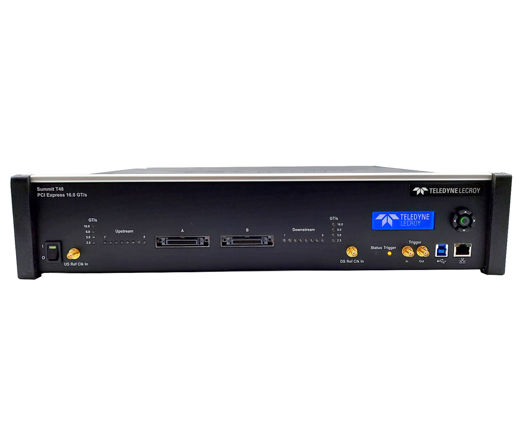
Teledyne LeCroy PE171AAA-X
Summit T48 (licensed as a Gen4 x4 analyzer,
Rent or Lease • Buy Used
Teledyne LeCroy - PE171AAA-X
The Teledyne LeCroy PE171AAA-X Summit T48 (licensed as a Gen4 x4 analyzer, no probes or cables) Hardware/Software Bundle.
PE171AAA-X Product Highlights
• Find errors fast
• One button error check
• Fast upload speed
• Large trace memory
Teledyne LeCroy & TRS-RenTelco
TRS-RenTelco is a proud partner of Teledyne LeCroy and offers a wide range of rental, purchase and leasing solutions designed specifically to meet the evolving needs of the electronic testing industry. Our close relationship with Teledyne LeCroy allows us to ensure we have the right Protocol Analyzers solution for your job.
Renting Protocol Analyzers
With TRS-RenTelco, renting Protocol Analyzers equipment has never been easier. Enjoy same-day shipping, lease, and finance options on our inventory of over 5000 electronic testing equipment rentals. As one of North America’s largest test equipment rental providers, it is our mission to support the endeavors of our clients no matter how big or small with reliable expertise, excellent customer service, accuracy, and speed.
Links to Additional Information
Teledyne LeCroy Products from TRS-RenTelco
- Configurations
- Resources
- FAQsAI
PE021UCA-X, PE171AAA-X, PE248SUA-A
See Configuration Details
-
PE021UCA-X
G4 x1, x4, x8 Y-Cable
-
PE171AAA-X
Summit T48 (licensed as a Gen4 x4 Analyzer, no Probes or Cables) Hardware/Software Bundle
-
PE248SUA-A
NVMe Enhanced Mode for Summit T48
Standard Rental Accessories*
* Leased or Buy Used product accessories will be confirmed with quote.
-
Cord Power
Qty: 1 -
Cable USB3.0-A - USB3.0-B 1 m
Qty: 1 -
Cable Patch Cat5e RJ45(m) - RJ45(m) Straight
Qty: 1 -
Cable Y-Type PE021UCA-X Summit T416 x 8
Qty: 1 -
SW-Manuals on USB
Qty: 1
*This item has already been added to your cart. Check your cart for quantity and availability.
PE021UCA-X, PE171AAA-X, PE248SUA-A, TS003XXX-W, TS016XXX-W
Standard Rental Accessories*
* Leased or Buy Used product accessories will be confirmed with quote.
-
Cable USB3.0-A - USB3.0-B 1 m
Qty: 1 -
Cable Patch Cat5e RJ45(m) - RJ45(m) Straight
Qty: 1
*This item has already been added to your cart. Check your cart for quantity and availability.
PE171AAA-X
See Configuration Details
-
PE171AAA-X
Summit T48 (licensed as a Gen4 x4 Analyzer, no Probes or Cables) Hardware/Software Bundle
Standard Rental Accessories*
* Leased or Buy Used product accessories will be confirmed with quote.
-
Cord Power
Qty: 1 -
Cable Patch Cat5e RJ45(m) - RJ45(m) Straight
Qty: 1 -
SW-Manuals on USB
Qty: 1 -
Cable USB-A - USB-B
Qty: 1
*This item has already been added to your cart. Check your cart for quantity and availability.

Datasheet - Teledyne LeCroy Protocol Analyzers PE171AAA-X
Content is AI-generated. Verify critical details with manufacturer-provided resources.
What PCIe generation and lane widths does the Summit T416 protocol analyzer support?
The Summit T416 protocol analyzer supports PCI Express 4.0 with data rates of 2.5 GT/s, 5.0 GT/s, 8.0 GT/s, and 16.0 GT/s across lane widths from x1 to x16. Capturing is performed by connecting a Gen4 interposer to the Device Under Test, with interposers available in x1, x4, x8, and x16 lane widths. The analyzer provides reliable and complete decodes of Transaction Layer Packets (TLPs), Data Link Layer Packets (DLLPs), and all primitives for all lane widths.
How much trace memory does the Summit T416 analyzer offer?
The Summit T416 protocol analyzer offers up to 128 GB of recording memory depth. This large trace memory enables extended capture sessions and comprehensive analysis of PCIe traffic over long periods. The deep memory buffer ensures 100% data capture even at the highest data rates up to x16 at 16 GT/s, allowing engineers to capture rare events and analyze complex interactions between PCIe devices.
What storage protocols does the Summit T416 decode?
The Summit T416 supports decoding of PCIe storage protocols including NVM Express (NVMe), SATA Express (both AHCI and ATA), and NVMe-MI management interface. Additional decodes available include SCSI Express (PQI and SOP), TCG Trusted Computing Group, Precision Time Measurement (PTM), and virtualization protocols such as Single and Multi-Root I/O Virtualization (SRIOV and MRIOV) as well as Address Translation Services (ATS).
What analysis views are available in the Summit T416 software?
The Summit T416 utilizes multiple intuitive views for analyzing PCIe traffic including the industry-standard CATC Trace view, Spreadsheet View, LTSSM State View, and Bit Tracer View. These interfaces help find errors fast through powerful triggering, filtering, and error reporting. The software provides meaningful reports about performance and protocol behavior in real time and post-capture, with the ability to drill down to areas of interest or collapse fields that are not relevant.
Does the Summit T416 support MultiPort analysis capability?
Yes, the Summit T416 supports MultiPort analysis, which allows simultaneous monitoring and correlation of traffic across multiple PCIe links. This capability is essential for analyzing complex systems with multiple interconnected PCIe devices, such as switches, bridges, and multi-port controllers. The synchronized capture enables engineers to understand how traffic flows through the entire system and identify timing relationships between different links.
What is the Trace Expert analysis feature on the Summit T416?
Trace Expert is an automated analysis feature that embeds detailed knowledge of the PCIe protocol hierarchy and intricacies as defined in the specification. It automatically alerts users as violations are detected at all levels of the protocol layering, providing one-button error checking. This expert system helps engineers quickly identify protocol violations, performance issues, and compliance problems without requiring deep manual analysis of captured traces.
What are the minimum host machine requirements for the Summit T416?
The Summit T416 requires a host machine running Microsoft Windows 10, Windows 8.1, or Windows 7 with at least 2 GB of RAM. Storage must have at least 200 MB of free space for software installation plus additional space for recorded data. The display should have minimum resolution of 1024x768 with 16-bit color depth. Connection options include USB 2.0 port and 100/1000baseT Ethernet, though optimal performance may require higher specifications as detailed in the product documentation.
What triggers and synchronization capabilities does the Summit T416 provide?
The Summit T416 includes dedicated trigger input and output ports for synchronization with external test equipment. The analyzer provides powerful triggering and filtering capabilities to isolate specific protocol events, errors, or traffic patterns. Sync in/out ports enable coordination with other test instruments, while DS and US reference clock inputs support precise timing measurements. The system can trigger on protocol-level events and capture the surrounding traffic for comprehensive analysis.