


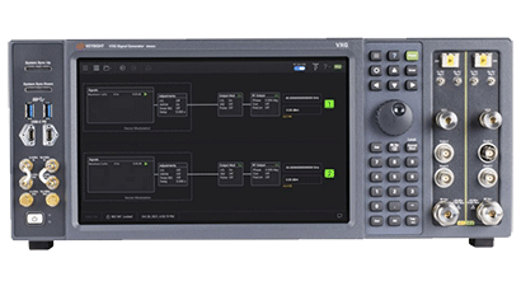


Keysight Technologies M9484C-554
54 GHz VXG Microwave Signal Generator
Rent or Lease
Keysight Technologies M9484C-554
The Keysight Technologies M9484C is the industry's first dual-channel vector signal generator capable of generating signals up to 54 GHz with 2.5 GHz of modulation bandwidth per channel. The VXG vector signal generator helps you deliver the next frontier of wireless technology such as 5G and satellite communications with a fully integrated, calibrated, and synchronized solution.
M9484C-554 Product Highlights
• Supports MIMO real-time fading for all 3GPP 5G NR base station conformance tests with PathWave Signal Generation software
• Covers all 5G NR frequency bands and V- / W-band for satellite communications
• Generates complex wideband signals needed for carrier aggregation and digital pre-distortion (DPD) applications
• Delivers superior RF performance for accurately characterizing devices under test, such as phase noise, error vector magnitude (EVM), and adjacent channel power ratio (ACPR)
• Simplifies MIMO and beamforming test setups with up to 4 synchronized and phase-coherent channels in one instrument and more than 32 channels in multiple instruments
• Streamlines complex receiver test scenarios with the world’s first 8-virtual-signal emulation per RF channel
Keysight Technologies & TRS-RenTelco
TRS-RenTelco is a proud partner of Keysight Technologies and offers a wide range of rental, purchase and leasing solutions designed specifically to meet the evolving needs of the electronic testing industry. Our close relationship with Keysight Technologies allows us to ensure we have the right Generators solution for your job.
Renting Generators
With TRS-RenTelco renting Generators equipment has never been easier. Enjoy same-day shipping, lease, and finance options on our inventory of over 5000 electronic testing equipment rentals. As one of North America’s largest test equipment rental providers, it is our mission to support the endeavors of our clients no matter how big or small with reliable expertise, excellent customer service, accuracy, and speed.
Additional Information
Manufacturer Home Page | Keysight Technologies.
- Configurations
- Resources
- FAQsAI
--, 001, 1EC, 554, 600, M20, R25, ST6
See Configuration Details
-
001
Add channel 1
-
1EC
High output power, 9 kHz to 54 GHz
-
554
CW Frequency range, 9 kHz to 54 GHz
-
600
Enhanced high performance reference
-
M20
Baseband generator memory upgrade to 2048 MSa
-
R25
RF bandwidth, 2.5 GHz with 256 MSa memory
-
ST6
Enhanced low phase noise
Standard Rental Accessories*
* Leased or Buy Used product accessories will be confirmed with quote.
-
1.85mm (f-f) adapter
Qty: 1 -
USB Drive with Software and Manuals
Qty: 1 -
Power Cord Assembly Heavy Duty with Square Plug
Qty: 1 -
Transit case for M9484C
Qty: 1 -
50 ohm SMA Terminator, male
Qty: 2 -
M9484C Cable Assy, Jumper, 15 mm
Qty: 2 -
Cable Assy, Jumper, 16 mm
Qty: 1
*This item has already been added to your cart. Check your cart for quantity and availability.
--, 001, 002, 1EC (1ST), 1EC (2ND), 500 (1ST), 500 (2ND), 554 (1ST), 554 (2ND), M40 (1ST), M40 (2ND), PCH, R25 (1ST), R25 (2ND), ST5 (1ST), ST5 (2ND)
See Configuration Details
-
001
Add channel 1
-
002
Add channel 2
-
1EC (1ST)
High output power, 9 kHz to 54 GHz
-
1EC (2ND)
High output power, 9 kHz to 54 GHz
-
500 (1ST)
High performance reference
-
500 (2ND)
High performance reference
-
554 (1ST)
CW Frequency range, 9 kHz to 54 GHz
-
554 (2ND)
Frequency range, 9 kHz to 54 GHz
-
M40 (1ST)
Baseband generator memory upgrade to 4096 Msa
-
M40 (2ND)
Baseband generator memory upgrade to 4096 Msa
-
PCH
Phase coherency for N channels
-
R25 (1ST)
RF bandwidth, 2.5 GHz with 256 MSa memory
-
R25 (2ND)
RF bandwidth, 2.5 GHz with 256 MSa memory
-
ST5 (1ST)
Low phase noise
-
ST5 (2ND)
Low phase noise
Standard Rental Accessories*
* Leased or Buy Used product accessories will be confirmed with quote.
-
Power Cord Assembly Heavy Duty with Square Plug
Qty: 1 -
Transit case for M9484C
Qty: 1 -
1.85mm (f-f) adapter
Qty: 2 -
50 ohm SMA Terminator, male
Qty: 2 -
USB Drive with Software and Manuals
Qty: 1 -
M9484C Cable Assy, Jumper, 15 mm
Qty: 2 -
Cable Assy, Jumper, 16 mm
Qty: 1
*This item has already been added to your cart. Check your cart for quantity and availability.
--, 001, 1EC, 403, 554, 600, 8SG, M20, R25, ST6
See Configuration Details
-
001
Add channel 1
-
1EC
High output power, 9 kHz to 54 GHz
-
403
Calibrated AWGN
-
554
CW Frequency range, 9 kHz to 54 GHz
-
600
Enhanced high performance reference
-
8SG
8 virtual signal generators (multiple IQ paths to RF)
-
M20
Baseband generator memory upgrade to 2048 MSa
-
R25
RF bandwidth, 2.5 GHz with 256 MSa memory
-
ST6
Enhanced low phase noise
*This item has already been added to your cart. Check your cart for quantity and availability.

Datasheet - Keysight Technologies M9484C
User Manual - Keysight Technologies M9484C
Content is AI-generated. Verify critical details with manufacturer-provided resources.
What is the frequency coverage of the Keysight M9484C-554 VXG?
The Keysight M9484C-554 VXG vector signal generator covers a frequency range from 9 kHz to 54 GHz with 0.00001 Hz CW frequency resolution. This wide frequency coverage makes it ideal for testing next-generation wireless communications, radar systems, and aerospace/defense applications requiring signals at millimeter-wave frequencies with precise frequency control.
What maximum output power does the M9484C-554 provide?
The M9484C-554 maximum output power varies by frequency and configuration. In standard configuration, it provides up to +18 dBm from 10 MHz to 32 GHz, +15 dBm from 32 GHz to 43 GHz, and +10 dBm from 50 GHz to 54 GHz. With option 1EC, maximum output power reaches +22 dBm typical from 22.5 GHz to 32 GHz and +19 dBm typical from 43 GHz to 50 GHz, significantly extending test capabilities at higher power levels.
How does the flexible reference input option work on the M9484C?
With option 1ER, the M9484C supports a flexible reference input accepting frequencies from 1 MHz to 110 MHz with 0.1 Hz setting resolution. This allows locking to various external reference sources beyond the standard 10 MHz or 100 MHz inputs. The system provides both wide locking range (plus or minus 1.0 ppm nominal optimized for best phase stability) and narrow locking range (plus or minus 0.6 ppm nominal optimized for best close-in phase noise).
What phase noise performance does the M9484C-554 achieve?
With options ST6 or 600, the M9484C-554 delivers exceptional phase noise performance in enhanced SNR mode at +10 dBm. At 10 GHz carrier, typical SSB phase noise is -121 dBc/Hz at 1 kHz offset, -132 dBc/Hz at 10 kHz offset, and -136 dBc/Hz at 100 kHz offset. At 54 GHz, typical performance is -111 dBc/Hz at 1 kHz offset, -123 dBc/Hz at 10 kHz offset, and -125 dBc/Hz at 100 kHz offset.
What vector modulation bandwidth is available on the M9484C-554?
The M9484C-554 with vector modulation options Bxx or Rxx provides internal baseband generation and wideband modulation capability. The instrument supports generation of complex wideband signals for testing 5G NR with multiple component carriers at bandwidths up to 800 MHz using 8cc x 100 MHz configurations with 256QAM and 120 kHz SCS. This capability addresses the demanding modulation bandwidth requirements of next-generation wireless communications systems.
How accurate is the output power level of the M9484C-554?
The M9484C-554 provides excellent absolute level accuracy in CW mode. From 12 MHz to 6 GHz, accuracy is less than plus or minus 0.6 dB (plus or minus 0.3 dB typical) with ALC on for +15 dBm or maximum power down to -60 dBm. From 20 GHz to 37 GHz, accuracy is less than plus or minus 0.7 dB (plus or minus 0.3 dB typical). For modulated signals such as 5G NR 8cc x 100 MHz with 256QAM, accuracy is plus or minus 1.5 dB nominal from 20 GHz to 54 GHz.
Does the M9484C support dual-channel phase-coherent operation?
Yes, with option PCH, the M9484C-554 supports dual-channel operation with precise relative phase control. Relative phase offset range is plus or minus 180 degrees with 0.001 degree resolution and 0.0001 degree nominal repeatability when tuning frequency. This phase-coherent capability is essential for MIMO testing, beamforming applications, and other multi-channel test scenarios requiring precise phase relationships between channels.
What pulse modulation features are available on the M9484C-554?
The M9484C-554 with option PMR or PME provides comprehensive pulse modulation including an internal pulse generator with modes for square, adjustable, doublet, and pulse train (SCPI only). Pulse period ranges from 60 ns to 42 seconds, with pulse width from 30 ns to 41.99 seconds. The pulse train generator with option 320 supports up to 2047 pulse patterns with on/off time range from 30 ns to 42 seconds, enabling complex pulsed radar and communication signal simulation.


